


During lockdown, we took a few online cooking classes with Thomas Keller, one of the true masters of French cuisine. With plenty of time on our hands, we cooked our way through all of his lessons and fell in love with the classic French sauces.

One series focused on the five French Mother Sauces:
-
Béchamel
-
Velouté
-
Espagnole
-
Sauce Tomate
-
Hollandaise
Under these Mother Sauces come countless variations, one of our favorites was the Béarnaise Sauce.
What Is a Mother Sauce?
A Mother Sauce is a foundational sauce in French cuisine; it is a base liquid combined with a thickening agent and additional ingredients that add flavor. From these bases, endless variations (known as daughter sauces) are created.
All of the Mother Sauces begin with a roux (a cooked mixture of butter and flour), except for Hollandaise, which uses egg yolks as the thickener. Of all the Mother Sauces, the easiest to master is Béchamel, made with just three ingredients: butter, flour, and milk. I use it all the time.
Béarnaise Sauce was definitely one of the hardest sauces to master as it takes time, patience, and a lot of butter. There were plenty of broken batches along the way, but with practice (and persistence), I finally got it right.
Now, I can whip up a silky Béarnaise with the snap of a finger… kind of!
What is Béarnaise Sauce ? Béarnaise Sauce is a rich, buttery sauce made with egg yolks, melted butter, and white wine vinegar, then flavored generously with tarragon. We’re big tarragon fans in our kitchen; its slightly sweet, anise-like flavor finds its way into everything from sauces to our everyday salad dressings.
Ideally, you’d use a double boiler to make Béarnaise, but since I don’t have one and find that using a glass bowl over simmering water (bain-marie) can be a bit of a mess, I’ve mastered making it right in a saucepan instead.
Just remember: this sauce takes time and patience. Go slow, keep an eye on the temperature, and don’t rush the whisking!
Let’s talk ingredients. I’ve seen all sorts of variations out there, everything from rice vinegar to green onions; but a traditional French Béarnaise Sauce keeps things simple and precise.
First, let’s clear something up: Béarnaise Sauce does not include lemon juice, that’s for Hollandaise. The acid used here is white wine vinegar, and I can’t stress this enough: use a high-quality white wine vinegar. Skip the distilled or bargain versions (and definitely skip rice vinegar). The flavor of your vinegar makes a huge difference.
When it comes to aromatics, shallots are key. No yellow onions, green onions, or garlic — their flavors are too strong. A delicate shallot gives the sauce its signature balance.
And then there’s the tarragon, fresh is where it’s at! Thankfully, most grocery stores carry it year-round now.
Now, about the butter… oh, the butter! I’ve tested them all; Kerrygold, Strauss, Clover and I’ve found that a high-fat French butter creates the creamiest, thickest Béarnaise. Skip the margarine or vegan alternatives for this one. It’s a fancy sauce, so go ahead and splurge a little.
Tips for the Perfect Béarnaise Sauce
Saucepan:
If you have a double boiler, please use it! I don’t, so I make mine in a small, heavy-bottomed 2-quart copper saucepan. I’ve found that using a smaller pan keeps the sauce closer together, which helps prevent it from breaking.
Low Heat:
If you’re not using a double boiler, keep the heat as low as possible; low, low, low! Don’t be tempted to turn it up, or you’ll end up with scrambled eggs instead of a silky sauce.
Ingredients:
(See above!) This is one of those times to splurge and use the best-quality ingredients you can especially when it comes to the tarragon and butter.
Steps:
Follow the steps exactly and have all of your ingredients prepped before you begin. Once you start whisking over low heat, you won’t have time to run back and chop tarragon or measure vinegar. Be prepared!
What If It Breaks? Well… good luck. Honestly, I’ve never had much success bringing a broken Béarnaise back to life. Hopefully, if it does decide to break, it happens early on before you’ve wasted all that precious (and pricey!) butter.
How to Store Béarnaise Sauce
I typically use Béarnaise Sauce right away, and honestly, we rarely have leftovers. But for the sake of this post, I experimented with storing and reheating it – twice.
The first time, I placed about half of the sauce in the fridge and tried reheating it five hours later. I added a tablespoon of warm water to the saucepan along with the sauce and warmed it over very low heat. Unfortunately, it broke almost immediately.
The second time, I reheated the sauce the next day, placing it alone in the saucepan over low heat and whisking like crazy. This time it held together beautifully and it stayed thick, rich, and didn’t break.
Lesson learned: Béarnaise doesn’t love to be reheated, but if you must, skip the added water and go slow and steady over low heat.
What to Eat Béarnaise with:
Béarnaise Sauce is a classic for a reason, it’s rich, flavorful, and versatile. You can enjoy it with:
-
Vegetables — like roasted, grilled or steamed asparagus
-
Grilled or roasted chicken
-
Poached eggs — as a delicious alternative to Hollandaise
-
Steak — and really, nothing beats a perfectly cooked filet with a generous drizzle of Béarnaise
- Chateaubriand – a classic that matches perfectly.
It’s a sauce that elevates almost any dish, so don’t be shy about experimenting!
Years ago we made a video, that clearly needs an update!
Here is another classic French sauce, Roquefort Sauce that is equally as delicious (and easy to make) with a beautifully prepared steak.

Béarnaise Sauce

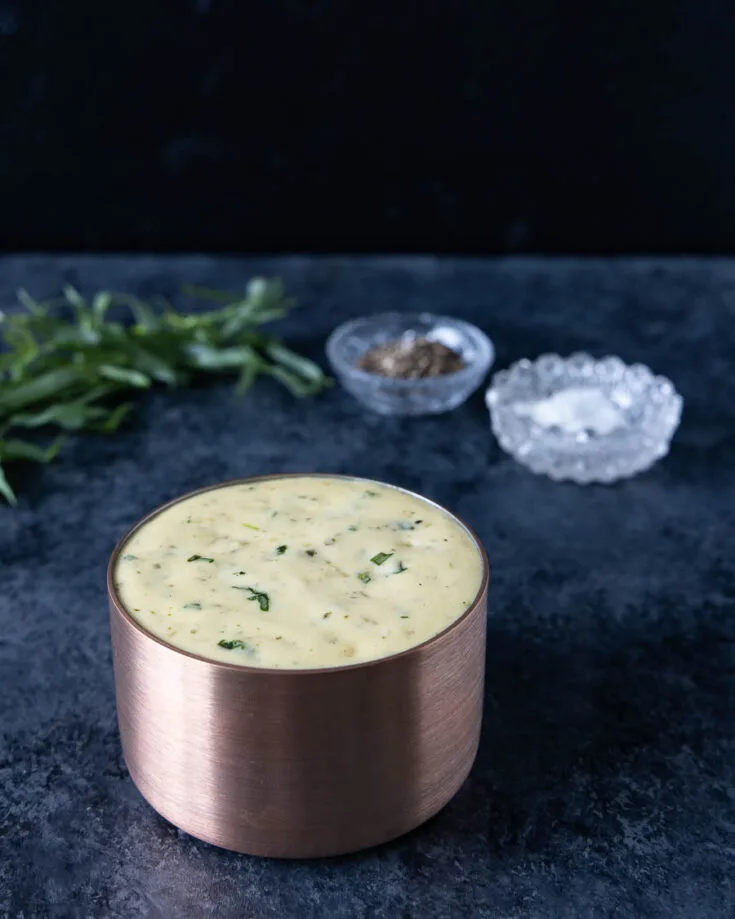
Classic Béarnaise Sauce made easy , creamy, buttery, and flavored with shallots and fresh tarragon.
Ingredients
- 1/4 cup high-quality white wine vinegar
- 1/4 cup water
- 1 small shallot (about 30 grams), peeled and finely minced
- 1/4 teaspoon black pepper
- 2 tablespoons fresh tarragon, finely minced (divided into 1 tablespoon each)
- 2 large egg yolks (save the whites for meringues)
- 3/4 cup butter, full-fat, preferably sea salted
Instructions
Prepare the vinegar reduction: In a small saucepan over low heat, combine the vinegar, water, shallot, 1 tablespoon tarragon, and black pepper. Bring to a boil, then reduce to a low simmer. Simmer until the mixture reduces to about 2 1/2 tablespoons. Pour into a small bowl and set aside to cool completely. If you’re short on time, place it in the fridge to chill.
Melt the butter: Melt the butter and set aside in a small bowl. Start the emulsion: Wash and dry your saucepan. Add the cooled vinegar-shallot mixture, 1 tablespoon hot water, and the egg yolks. Whisk vigorously to combine — I really mean whisk a lot!
Cook over low heat: Place the pan over very low heat, continuing to whisk constantly. Don’t stop until the mixture is thick and has roughly doubled in volume — about 8–10 minutes. Patience is key; stop whisking and you’ll have scrambled eggs instead of Béarnaise. Trust me!
Add the butter slowly: Add the melted butter 1 tablespoon at a time, whisking thoroughly after each addition. Don’t rush or dump it all in at once! Occasionally, you can move the saucepan to the counter while whisking to prevent overheating; the whisking may slow slightly, which is fine. Continue until all the butter is incorporated and the sauce is thick and creamy.
Finish and serve: Stir in the remaining 1 tablespoon tarragon.
Taste and season with additional salt and pepper if desired.
Serve immediately over steak, vegetables, eggs, or whatever you like!
Notes
Do not be tempted to rush the cooking process, low and slow. Whisking the entire time. Once the sauce is finished cooking, pour it immediately into a serving bowl. Do NOT let it sit in the saucepan on the stove while you prepare rest of the meal. It will separate and break.